
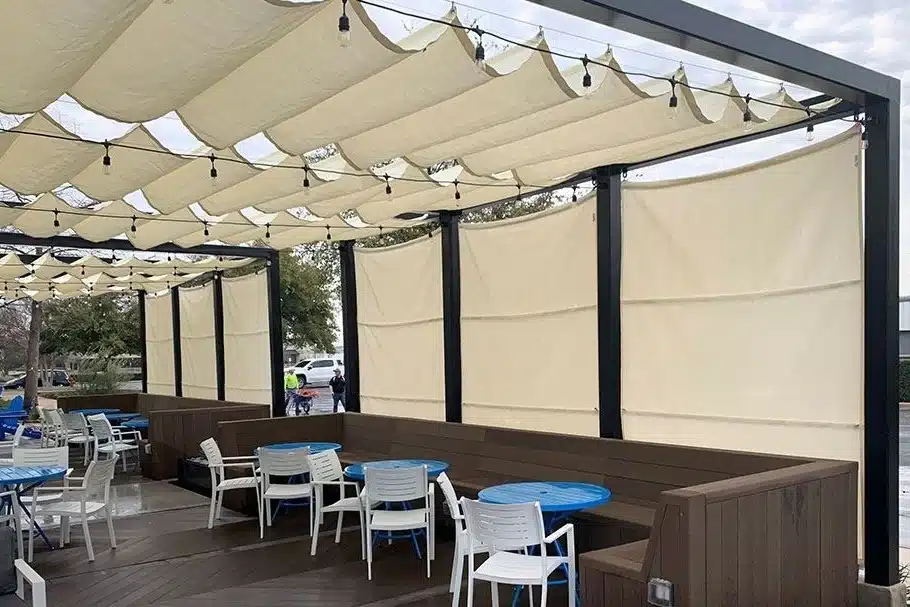
When the Austin temperature hits 105°F in July, your Rainey Street patio empties out by noon. Those twenty outdoor tables generating $8,000 in daily revenue? They sit vacant while your servers watch potential customers walk past to air-conditioned competitors. The brutal Central Texas summer heat doesn’t just make diners uncomfortable—it directly hemorrhages your bottom line for five months every year.
Austin restaurants with unshaded patios lose an estimated 40-60% of their outdoor seating revenue during peak summer months (Source: Texas Restaurant Association, 2023). That’s a problem unique to your market: you’ve invested in prime outdoor real estate on South Congress or East 6th Street, yet you can only monetize it reliably from October through April. Commercial patio shades solve this revenue leak by transforming your outdoor space into a year-round profit center.
Why Austin’s Climate Demands Commercial-Grade Shade Solutions
Your patio isn’t fighting ordinary summer heat. Austin averages 116 days per year above 90°F, with peak summer temperatures regularly exceeding 100°F (Source: National Weather Service Austin/San Antonio, 2023). The combination of direct solar radiation and reflected heat from concrete and glass surfaces in modern mixed-use developments like The Domain creates surface temperatures exceeding 140°F on unshaded patios.
The Revenue Impact of Unshaded Outdoor Dining
Consider what happens to your cash flow when summer arrives:
- Lunch service collapses—outdoor tables become unusable by 11 AM from May through September
- Happy hour revenue drops 35-50%—the 4-7 PM window coincides with peak heat index readings
- Staff turnover increases—servers working unshaded patios experience heat stress and request indoor sections
- Food quality suffers—dishes cool rapidly or wilt under direct sun, generating complaints and comps
Quality commercial shade structures reduce ambient temperatures underneath by 15-25°F compared to direct sun exposure (Source: U.S. Department of Energy Building Technologies Office, 2022). That temperature difference determines whether your patio operates profitably through August or sits empty until fall.
Austin Energy Costs and Shade ROI
Unshaded patios don’t just lose outdoor revenue—they increase your indoor cooling costs. Austin Energy commercial rates averaged $0.087 per kWh in 2023 (Source: Austin Energy Rate Schedule, 2023), and restaurants with south-facing or west-facing glass walls adjacent to unshaded patios see HVAC costs spike 18-23% during summer months. Properly positioned commercial shade structures reduce solar heat gain through adjacent windows, lowering your overall energy consumption while making outdoor dining viable.
Commercial Shade Options for Austin Restaurant Architectures
Your building’s architecture determines which shade solutions will work—and which will create permitting nightmares or structural problems. Austin’s restaurant landscape includes everything from historic downtown storefronts on 2nd Street District to converted warehouse patios on East 6th Street to sleek modern developments throughout The Domain. Each requires a different approach.
Retractable Awning Systems for Historic Storefronts
Historic buildings along South Congress Avenue and the 2nd Street District often have preservation requirements limiting permanent structural modifications. Retractable fabric awning systems mount to existing building facades without altering the historic character. These systems extend to provide 95%+ UV blockage during peak hours, then retract completely for evening ambiance or during Austin’s spectacular spring weather.
Key specifications for Austin’s climate:
- Commercial-grade acrylic fabrics rated for 1,500+ hours of UV exposure annually
- Wind sensors that automatically retract awnings during sudden thunderstorms
- Motorized operation allowing staff to adjust coverage throughout service
- Projection depths up to 16 feet for covering multiple table rows
Permanent Shade Structures for Modern Developments
Newer Austin restaurants in mixed-use developments often have rooftop patios or dedicated outdoor areas that can accommodate permanent shade structures. Aluminum pergolas with adjustable louver systems offer the most versatility—fully closed for rain protection, partially open for filtered light, or completely open for evening stargazing. These structures can span up to 40 feet without intermediate supports, preserving sightlines and maximizing flexible table arrangements.
Tension Shade Sails for Converted Warehouse Spaces
The industrial aesthetic of converted warehouse patios along Rainey Street and East 6th Street pairs naturally with architectural tension shade sails. These fabric membrane structures mount to steel posts or existing building elements, creating dramatic geometric shade patterns that complement the neighborhood’s creative vibe. Properly engineered systems handle Austin’s occasional 60+ mph wind gusts while blocking 85-98% of UV radiation depending on fabric selection.
Comparing Commercial Shade Solutions: Cost, Durability, and ROI
Your shade investment must pay for itself through increased revenue and reduced operating costs. The following comparison reflects Austin market conditions and commercial-grade products suitable for restaurant applications:
| Shade Type | Installed Cost per Sq Ft | Lifespan | Temperature Reduction | Best Application |
|---|---|---|---|---|
| Retractable Awnings | $25-45 | 10-15 years | 15-20°F | Historic storefronts, flexible coverage |
| Aluminum Pergolas | $40-75 | 25-30 years | 20-25°F with louvers closed | Modern patios, permanent installations |
| Tension Shade Sails | $15-35 | 8-12 years | 15-22°F | Industrial aesthetics, large spans |
| Fixed Fabric Canopies | $20-40 | 10-15 years | 18-23°F | Budget-conscious, moderate coverage |
A typical 1,200 square foot Austin restaurant patio generating $150 per square foot annually can expect to recover a $45,000 shade investment within 12-18 months through extended summer operating hours alone. Factor in reduced Austin Energy bills and lower staff turnover, and the payback period shortens further.
Installation Considerations for Austin Restaurant Owners
Permitting requirements vary significantly depending on your location within Austin. Rainey Street District installations require Historic Landmark Commission review for any exterior modifications. South Congress properties may fall under the South Congress Combined Neighborhood Plan with specific design guidelines. The Domain and other newer developments typically have HOA or property management approval processes separate from city permitting.
Structural Engineering Requirements
Texas wind loads and the International Building Code require structural engineering for any shade structure exceeding 120 square feet. Your existing building may require reinforcement to handle awning attachment points, or freestanding structures may need concrete footings engineered for Austin’s expansive clay soils. A qualified commercial shade installer handles these engineering requirements as part of the project, but expect 4-8 weeks for permit approval in most Austin jurisdictions.
Installation Timeline and Minimizing Disruption
Most commercial shade installations complete within 2-5 days once permits clear. Schedule your installation during slower business periods—January and February offer the best combination of mild weather, lower restaurant traffic, and sufficient lead time before summer heat arrives. Request a free commercial shade consultation now to ensure your system is operational before the March SXSW crowds hit and summer follows close behind.
“Restaurants that invest in quality outdoor infrastructure see 23% higher customer retention rates compared to those relying on temporary solutions like patio umbrellas.” — National Restaurant Association Operations Report, 2023
Why Austin Restaurateurs Trust Local Shade Specialists
Generic shade vendors don’t understand the specific challenges of operating in Austin’s climate and regulatory environment. Local commercial shade specialists bring essential advantages:
- Established relationships with Austin permitting offices—faster approvals and fewer revision cycles
- Direct knowledge of neighborhood-specific requirements—Rainey Street historic guidelines versus Domain HOA standards
- Warranty service without shipping delays—local technicians respond within 24-48 hours for adjustments or repairs
- Material selections proven in Central Texas conditions—fabrics and hardware that withstand Austin’s UV intensity and temperature swings
Your outdoor dining space represents a significant percentage of your restaurant’s revenue capacity. Protecting that investment with commercial-grade shade solutions designed specifically for Austin’s brutal summers isn’t an expense—it’s infrastructure that pays dividends every day from May through September.
Ready to transform your patio into a year-round profit center? Request a free commercial shade consultation for your Austin restaurant today. Our team will assess your space, review your architectural requirements, and provide a detailed proposal covering shade options, permitting timeline, and projected ROI for your specific situation.
Frequently Asked Questions
How long does commercial shade structure installation take from initial consultation to completion?
Plan for 8-14 weeks total timeline for most Austin restaurant projects. The consultation and design phase takes 1-2 weeks, engineering and permit submission requires 2-3 weeks, permit review and approval runs 4-8 weeks depending on your location and structure type, and installation completes within 2-5 days once permits clear. Rainey Street District and other historic areas may require additional review time.
Do commercial shade structures require ongoing maintenance in Austin’s climate?
Annual professional inspection and cleaning extends shade structure lifespan by 30-40%. Austin’s combination of intense UV, summer dust, and occasional severe weather means fabric tensions require adjustment every 2-3 years, and hardware should be inspected for corrosion annually. Most commercial shade warranties require documented maintenance to remain valid.
Can shade structures be installed on leased restaurant spaces?
Yes, but landlord approval and lease terms matter significantly. Retractable awnings and tension shade sails can often be installed with minimal permanent modifications and removed at lease end. Permanent pergola structures typically require landlord co-investment or lease amendments addressing ownership and removal responsibilities. We recommend involving your landlord early in the consultation process.
Frequently Asked Questions
What is the typical warranty coverage for commercial restaurant shade structures in Texas?
Most commercial-grade shade structures carry 5-10 year warranties on structural components (frames, posts, mounting hardware) and 3-5 year warranties on fabric elements. Premium aluminum pergola systems often include 15-25 year structural warranties. Warranties typically cover material defects and workmanship but exclude damage from hurricanes, tornadoes, or impacts. Texas-specific conditions like hail damage may require separate insurance coverage rather than warranty claims.
Are there financing options available for restaurant shade structure investments?
Many commercial shade installers offer equipment financing with terms ranging from 24-60 months. Section 179 tax deductions allow Austin restaurant owners to deduct the full purchase price of qualifying shade structures in the year of installation rather than depreciating over time. SBA loans and commercial lines of credit also cover shade infrastructure as capital improvements. Typical financing approval requires 2+ years in business and demonstration of positive cash flow.
How do commercial shade structures perform during Austin’s severe thunderstorms and occasional hail events?
Retractable awnings with wind sensors automatically retract when gusts exceed 25-35 mph, protecting fabric from storm damage. Permanent structures like aluminum pergolas are engineered to withstand 90+ mph winds when properly installed with adequate footings. Tension shade sails are the most vulnerable to severe weather and may require manual removal if major storms approach. Hail resistance varies by material—solid aluminum louvers resist hail better than fabric membranes.

